


The MarTech workflow illustrates the blocks and junction points where observability fits in.
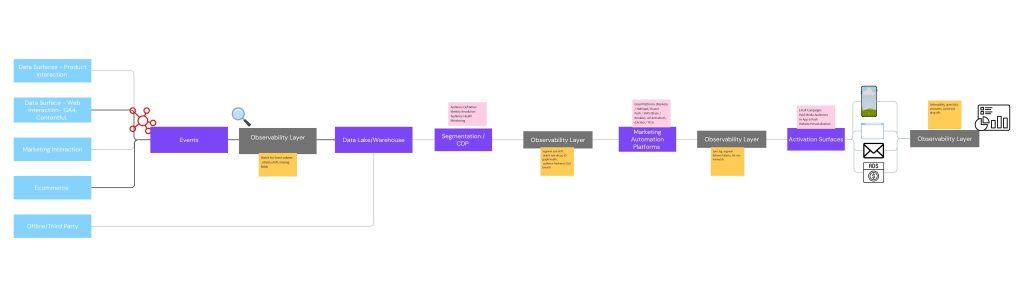
Each of those spaces you want to keep track of things like
- Event volume
- Schema drift,
- Missing fields,
- Segment size drift,
- Match rate decay,
- ID graph health,
- Audience freshness (SLA breach)
- Segment size drift,
- Deliverability,
- Open/click anomalies,
- Conversion drop-offs
At the end of the marketing cycle are dashboards that are tracking conversions. However, when something goes wrong, it becomes painstakingly hard to go trace the drop off at the source. And each time it becomes a new endeavor, a new Jira ticket, a new project to go uncover what is going on.
Where “full stack” SaaS providers make the most of their pitch – is hey we don’t lose your data. True, they don’t because for the most part they are the system of record. However, when you are connecting different systems, some with AI augmented, and some out of the box, there will be cracks and gaps. And the principle of Observability just comes in to fill those gaps.


Leave a Reply